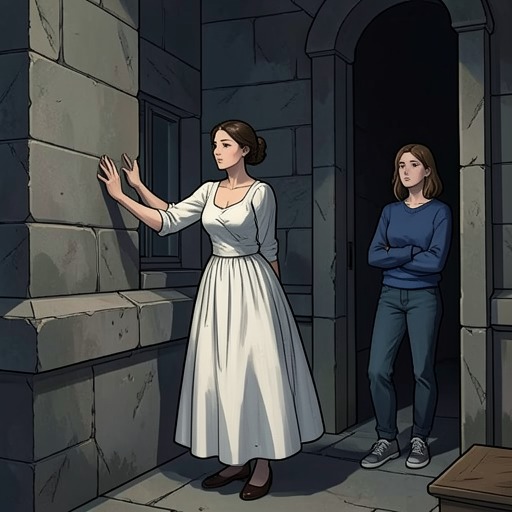
Death, Grief, and Carrying On
Gente que viene y ¡Bah!Death, Grief, and Carrying On is a central emotional thread after Ángela dies: the family must face an absence that initially feels impossible to bear, even as her words continue to shape how they understand one another and what comes next. The story gives no simple cure for grief. Instead, it follows the forms through which the dead remain connected to the living: an embrace, a red notebook, a family ritual, and the imperfect offer of someone who has also lost a loved one.
The shock of loss
Ángela’s death first reaches the family as a physical and emotional rupture. When Bea arrives, her sister embraces her and breaks down, asking what they will do without their mother. Bea cannot cry at first; she is still in shock. But when she sees her father, whose appearance has been altered by grief, she leaves her sister’s embrace and clings to him. In his arms she finally weeps without restraint. The gesture offers a moment of comfort, not an answer to the vast, cold absence she has felt since the previous day.
The circumstances of the death deepen Bea’s distress even though she was not present. León and Bea’s father found Ángela unconscious over the kitchen table, called an ambulance, and discovered that she had already stopped breathing. Bea feels an almost guilty relief that she did not have to find her mother that way, while recognizing that she would not have been able to face the scene. Her grief includes not only the fact of Ángela’s death but also the imagined moment she was spared.
The family’s first understanding of what happened is incomplete. Bea’s father asks whether anyone knew Ángela had been unusually tired or worried that she was losing her empathy, and the others say they did not know of her approaching death. Bea explains that Ángela had learned months earlier, after medical tests, that her heart would not last much longer. She did not know exactly how much time remained. Her silence was not simply an attempt to keep a secret: she hoped that if she did not say the danger aloud, it might never happen. The account makes the loss both sudden to the family and long anticipated by Ángela herself.
The notebook and an ongoing bond
Ángela dies while writing in her red Hello Kitty notebook. Its cover is familiar, but its purpose surprises Bea: the notebook bears her name and was intended for her. After the funeral home and crematorium, after condolences and the long, strange hours spent accepting that Ángela is gone, Bea withdraws to her childhood bedroom and holds the notebook before opening it. The room recalls the spring she spent at home, when her own troubles occupied her attention. Those problems now seem small beside her mother’s death, yet Bea is grateful that events brought her back and allowed them to share those months together.
The notebook changes the family’s relation to what Ángela knew and chose not to say. It lets her speak to each of them in turn, not by removing their grief but by giving it words and directions. When Bea reads the note addressed to Débora, Ángela tells her daughter that she knows she has inherited her gift, while refusing to demand that she continue the consultation work. She recognizes Débora’s search for a vocation and praises a photograph of Teo and the child as a work of art. Art, Ángela suggests, can also be a way of empathizing with others and channeling pain; if Débora ever wants the consultation, it is hers. The message acknowledges both a family inheritance and Débora’s freedom to choose another life.
A separate note addresses Fin, whose anxiety about death has eased through his sessions. Ángela’s blunt encouragement to stop fearing death and live strikes the family painfully: at that moment, they cannot agree that death is not a serious matter, because her death has left them feeling emptied and without a sense of meaning. The silence that follows shows the distance between advice written before a loss and the experience of receiving it afterward. The note does not make grief disappear; it confronts Fin’s earlier fear with the family’s present bereavement.
Ángela’s message to Bea turns from individual pain to the sisters’ relationships. She writes that they should make peace with one another, but believes her death will already have helped them recognize what their conflicts now look like beside the loss. She likens death to a device that can resolve a dramatic tangle, then makes the darker point that death renders other problems ridiculous. The three sisters understand each other without needing to speak. The insight produces no denial of sorrow; it changes the scale against which old resentments are measured. León identifies the theatrical device Ángela is trying to name, and a remark from the Civil Guard officer brings the family’s first laugh of the day. Humor enters the mourning not as a replacement for tears but as a brief sign that the family can still respond to one another.
Ritual, memory, and the living
The notebook also records Ángela’s wishes for her ashes. She wants them scattered from the cliff where Irene decided to move the Romanesque chapel, one of her favorite places. She had joked with Irene that the chapel had made the site a place of pilgrimage, and imagined that her choir friends, the priest, and her patients might interpret the scattering as a sign that she had finally entered the religious fold. Her humor remains part of the instruction: the family is asked to let people believe what comforts them.
The family goes to the cliff two days later. They had hoped for a private gathering, but many people hear of the plan and want to come. They do not turn them away, knowing Ángela would have welcomed their presence and that, in those days, the family also needs the warmth of others. In October the sky is clear and the sea calm. Bea had imagined the northern wind blowing the ashes back over them; instead, they fall into the water and disappear across the waves. The ritual marks a separation, while the chosen place and the people gathered there keep Ángela’s preferences and relationships within the family’s continuing life.
Learning to continue
Bea’s grief becomes acute again when she is alone with Diego in his car. The familiar smell of the leather seat makes her collapse into tears, and she tells him she cannot imagine living without her mother. She asks how he managed to live without Diana. For Bea, the thought of never seeing Ángela again is too overwhelming to contain; she does not ask for an explanation of death so much as for a way to endure its permanence.
Diego does not answer immediately. He starts the car and drives a couple of kilometers in silence, giving Bea room to release some of what she is carrying, or perhaps because he does not know what to say. He admits that he does not know how he survived Diana’s absence, and does not believe there is a right way to do it. He has spent more than two years making mistakes, but thinks he has finally learned something. He offers to help Bea if she wants him to. His response makes continuing possible without presenting it as mastery: grief remains difficult, and help comes from another bereaved person who can offer presence rather than a formula. Bea realizes that she wants that help and that it may be what allows her to go on.